
.
Sgioba Luaidh Inbhirchluaidh (Inverclyde Waulking Group) are an extremely impressive group who have visited Lismore twice, the first time on 20 July 2012 and the second a year later as part of the Crofters’ and Crafters’ day. They are preserving a skill and reminding us of a relatively recent time before textiles were cheap throwaways and their production exploited labour, ironically mainly women and children, and the planet.
Waulking (in Gaelic luadh) is the technique of finishing the newly-woven tweed by soaking it and thumping it rhythmically to shrink and soften it – all originally done by hand. The songs keep the rhythm and lighten the work. It’s the final stage in the long, laborious process of producing homespun woollen cloth. For many you wore what you could produce..
When tweed comes off the loom it is stiff and rough, and the weave is quite loose. Waulking thickens and softens it. Nowadays, of course, this is done by machinery, but formerly everything was done by hand – or even feet! The cloth was soaked in “household ammonia” (stale urine!) Known in Gaelic as maistir, this helped make the dyes fast, and to soften the cloth. (They admit their performances are not completely authentic – they don’t use maistir!)

Sgioba Luaidh Inbhirchluaidh (Inverclyde Waulking Group)
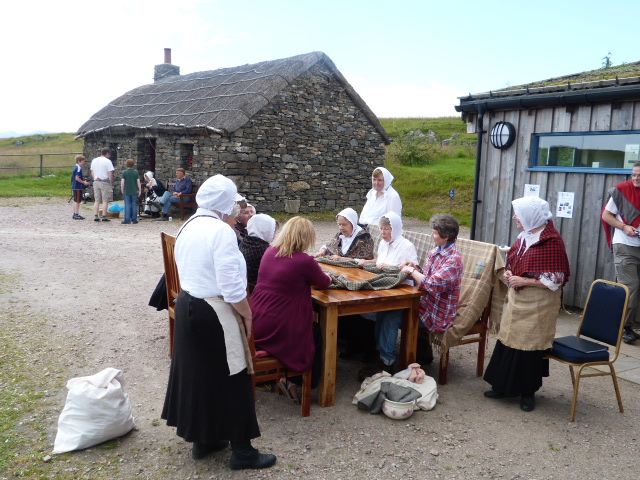
Sgioba Luaidh Inbhirchluaidh (Inverclyde Waulking Group)
For the women who took part, waulking was an enjoyable social occasion, with plenty of fun and gossip as well as hard work. Sgioba Luaidh (Waulking Team) try to capture the authentic atmosphere and succeed if their Lismore performances were anything to go by.
Although Waulking was a widespread practice, it seems that only in Scottish Gaelic culture was it accompanied by singing. Or, at least, it is only here that the songs have survived and some of the songs are centuries old. Being passed on orally, they have been transformed into many differing versions.
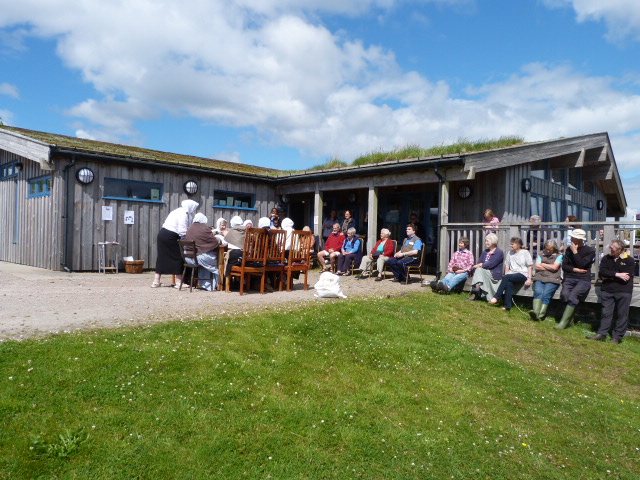
Sgioba Luaidh Inbhirchluaidh (Inverclyde Waulking Group)
One woman sings the verse of one or two lines. It seems effortless, but takes a lot of skill and practice to get the timing exactly right! The rest join in the chorus. The waulking would begin with a slow song, increasing in speed as the cloth dried, and the women got warmed up. In Uist and Barra, after being waulked the cloth was rolled up, and patted to smooth it out to the accompaniment of a clapping song (oran basaidh) which was a fast, cheerful song, sometimes an improvised “pairing off” song, when the names of those present would be linked with local young men.
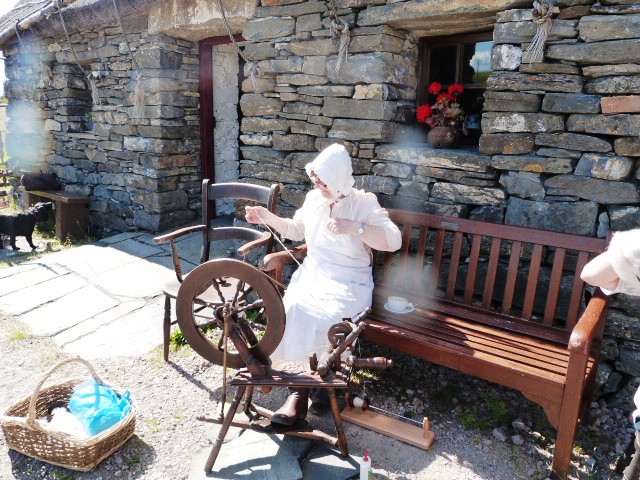
Sgioba Luaidh Inbhirchluaidh (Inverclyde Waulking Group) Freda Drysdale spinning 20. 07 12
Waulking died out in the mid-twentieth century, as cotton was produced industrially, synthetics took over and globalisation claimed the textile industry.
And a year later

Crofters’ and Crafters’ day 20 July 2013

Crofters’ and Crafters’ day 20 July 2013 Rolling up

Crofters’ and Crafters’ day 20 July 2013 Waulking the tweed