

This resettlement of Baligrundle and Craignich is undoubtedly one of the most far sighted and amazing things to have happened on Lismore or even in Scotland and its effects are still being felt by those of us who work and/or own the land today. The power brokers and landowners were faced down.
The Clearance: Between 1845 and 1865, 24 households, totaling over 100 people were cleared from Baligrundle and Craignich, by James Cheyne and later by his wife Frances. By 1870, no-one lived on Baligrundle and there was one shepherd household on Craignich. Even the new landlord, George, 8th Duke of Argyll, thought that clearance had gone too far: As he said to the Napier Commission in 1883: “I have no hesitation in saying that my property in Lismore is one of the few cases I know in which consolidation has been carried much too far.”
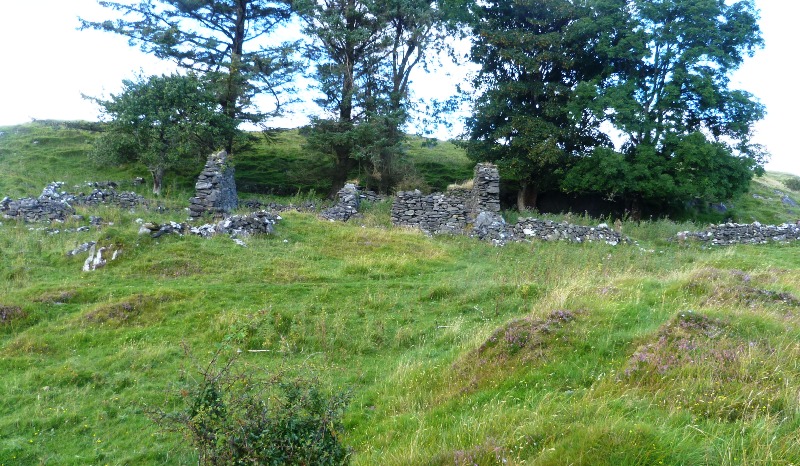
No 9 Craignich Clearance Cottage circa 1850s
He did not act but, following the security given to existing smallholders by the Crofters’ Act (1883), pressure for the release of more land was building – 61 men petitioned for land on Lismore in 1893.
Resettlement: In 1912, the Board of Agriculture for Scotland was established with the remit of land reform.In a letter to this board on 24 February 1913 John, 9th Duke of Argyll (who was married to Queen Victoria’s daughter) was “opposed to the breaking up of useful sized grazing farms such as Craignich and Baligrundle into small holdings, as proposed” .
Undaunted, the Board proceeded to break Craignich into 9, and Baligrundle into 4 crofts; to select 13 new tenants; to set fair rents; and to make arrangements for housing, steadings and fencing. The Duke remained the owner but the new crofters had security of tenure.
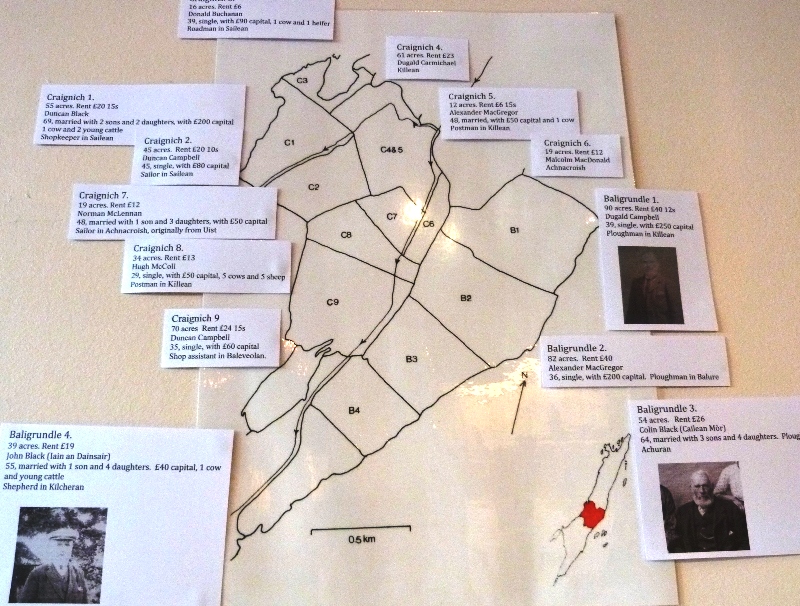
Baligrundle and Craignich allocation of crofts
Details as below:
Baligrundle 1. 90 acres. Rent £40 12s Dugald Campbell 39, single, with £250 capital Ploughman in Killean
Baligrundle 2. 82 acres. Rent £40 Alexander MacGregor 36, single, with £200 capital. Ploughman in Balure
Baligrundle 3. 54 acres. Rent £26 Colin Black (Cailean Mòr) 64, married with 3 sons and 4 daughters. Ploughman in Achuran
Baligrundle 4. 39 acres. Rent £19 John Black (Iain an Dainsair) 55, married with 1 son and 4 daughters. £40 capital, 1 cow and young cattle Shepherd in Kilcheran
Craignich 1. 55 acres. Rent £20 15s Duncan Black 69, married with 2 sons and 2 daughters, with £200 capital 1 cow and 2 young cattle Shopkeeper in Sailean
Craignich 2. 45 acres. Rent £20 10s Duncan Campbell 45, single, with £80 capital Sailor in Sailean
Craignich 3. 16 acres. Rent £6 Donald Buchanan 39, single, with £90 capital, 1 cow and 1 heifer Roadman in Sailean
Craignich 4.61 acres. Rent £23 Dugald Carmichael Killean
Craignich 5. 12 acres. Rent £6 15s Alexander MacGregor, 48, married, with £50 capital and 1 cow, Postman in Killean
Craignich 6. 19 acres. Rent £12 Malcolm MacDonald Achnacroish
Craignich 7. 19 acres. Rent £12 Norman McLennan 48, married with 1 son and 3 daughters, with £50 capital Sailor in Achnacroish, originally from Uist
Craignich 8. 34 acres. Rent £13 Hugh McColl 29, single, with £50 capital, 5 cows and 5 sheep Postman in Killean
Craignich 9 70 acres Rent £24 15s Duncan Campbell 35, single, with £60 capital Shop assistant in Baleveolan.
The Campbell Family Story
Dugald Campbell (1874-1953) was the grandson of John Campbell, farmer, who was cleared by the Cheynes from Fiart by 1853 and the son of Archibald Campbell, farmer, who was cleared from Craignich in 1861, becoming estate ground officer in Tirlaggan, finally farmer in Killean, where Dugald was born.
As the fourth son of the family, Dugald had to earn his living off the island (not present at the 1891 or 1901 censuses), where he gained a reputation as a fine ploughman (cupwinner in 1902 in Benderloch).
By 1913, he was ploughman on the family holding on Killean, single, 39, with savings of £250. He took possession of his new croft on Baligrundle in 1914, but it was not until 1923 (aged 48) that he married Flora Livingstone from Balimakillichan (aged 37). Their three children followed in 1925 (Archibald), 1926 (Mary) and 1929 (Annie), but Flora died young in 1937.
Archibald succeeded his father on Baligrundle 1 until his death in 1985. The family bought the croft in the 1970s.
Dugald Campbell (far left in this photo) was one of the men allocated a croft. Here he is with his son & one of his daughters and a friend.
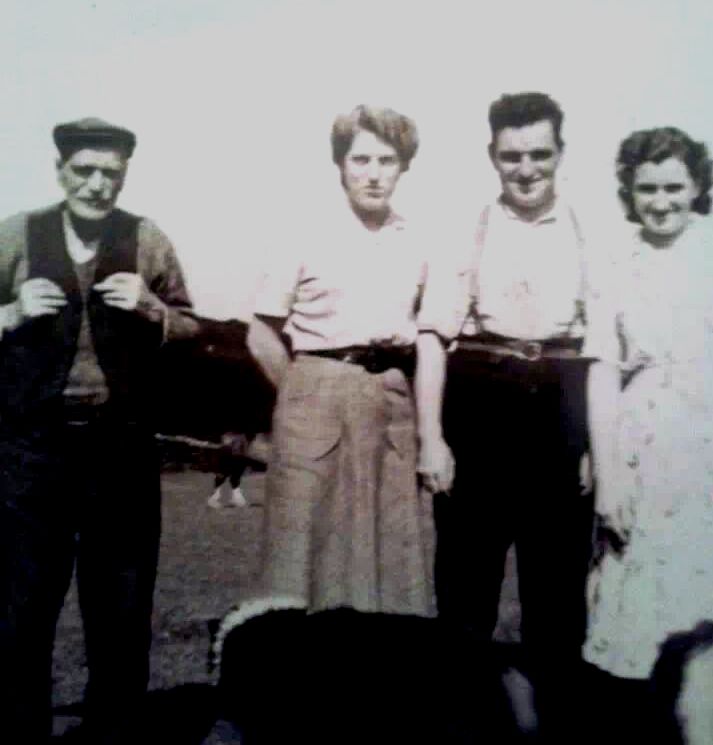
Campbell Family with Dugald on the left
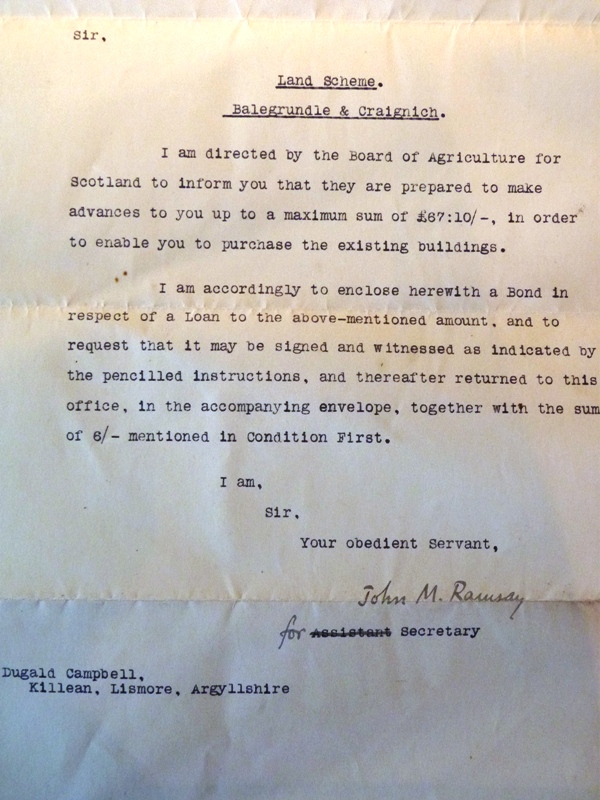
Campbell family correstpondence
Campbell Family correspondence
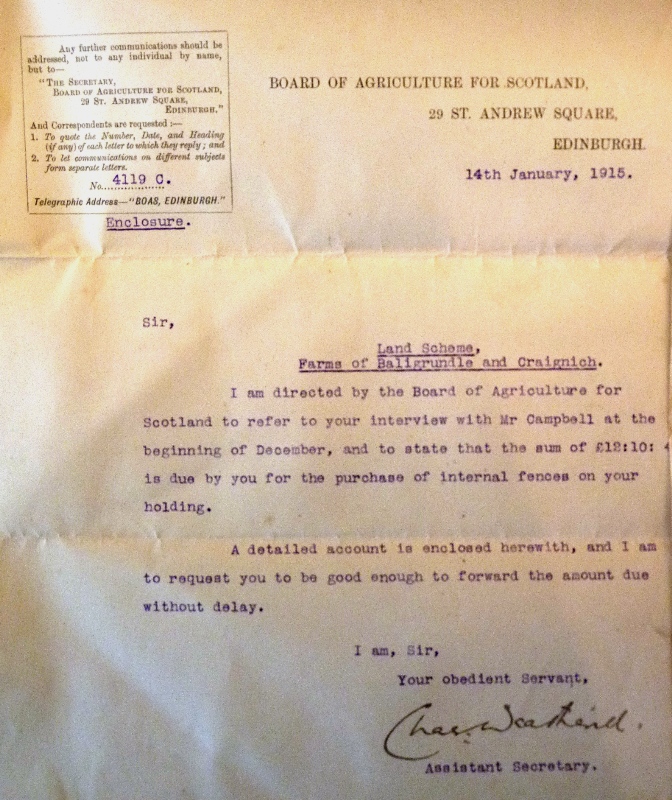
Campbell Family correspondence
No 9 Craignich
All the resettled crofts have a story to tell. No 9 Crignaich went to Duncan Campbell for a rent of £24 15s . He was single at 35, had £60 in capital and was a shop assistant in Baleveolan. He passed it to Duncan Campbell who may have been his son and, though I don’t know that for sure, I do know he worked in a shipping office in Edinburgh but worked the croft staying in a sort of lean to when he was in Lismore. His niece Morag Buchanan MacCormick (later Ross) was the next tenant and she was born and raised at the Mill in Balnagown became a Queen’s nurse in Glasgow and worked and married in Oban. She passed it to her son the now retired Captain Stuart MacCormick Ross who bought it from the Duke of Argyll in 1978 since which time he has worked it. He is a maths honours graduate from Glasgow University who worked deep sea with Blue Star Line and finally with the Northern Lighthouse Board. He lives in Lismore.
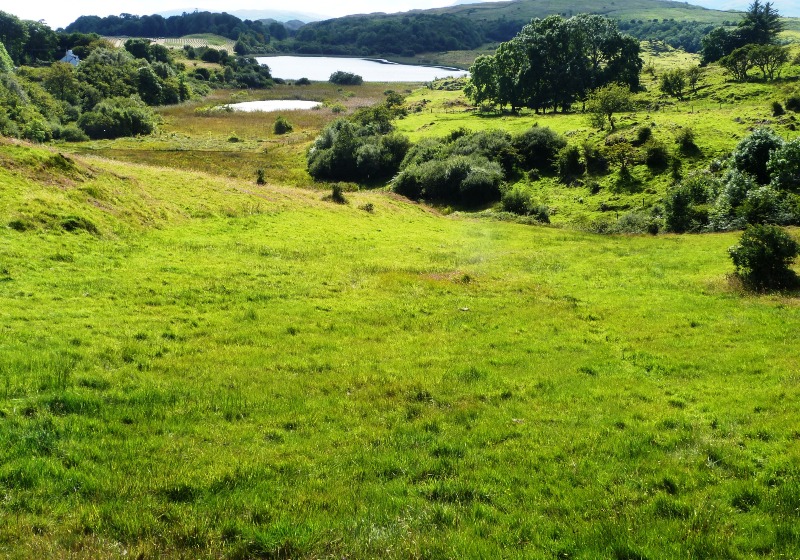
No 9 Craignich as it is today 2014
The croft is herb rich with an abundance of wild flowers. It has never been fertilised. He runs from 9 to 14 bullocks and a neighbouring crofter has some grazing for some sheep as well. The croft has no inner fences and both the sheep and the cattle roam freely sheltering in one of the small shelters or among the trees. They are mainly Aberdeen Angus but occasionally he has Limousin and/or Luing.

Cattle at Craignich