
Part One: Burning with Coal
As part of the Nave Archaeological Dig in August 2016, Mark Thacker supervised some experimental lime burning near the lime kilns at Park near Port Ramsay.
The popular way of small-scale lime burning with coal involves building a kiln with breeze blocks. We used 50 standard blocks, filled the cavity with layers of anthracite and broken limestone, sealed a paintpot chimney with local clay and fired the kiln from the bottom.

Lime burning at Park 25 October 2016

Lime burning at Park 25 October 2016

Lime burning at Park 25 October 2016

Lime burning at Park 25 October 2016
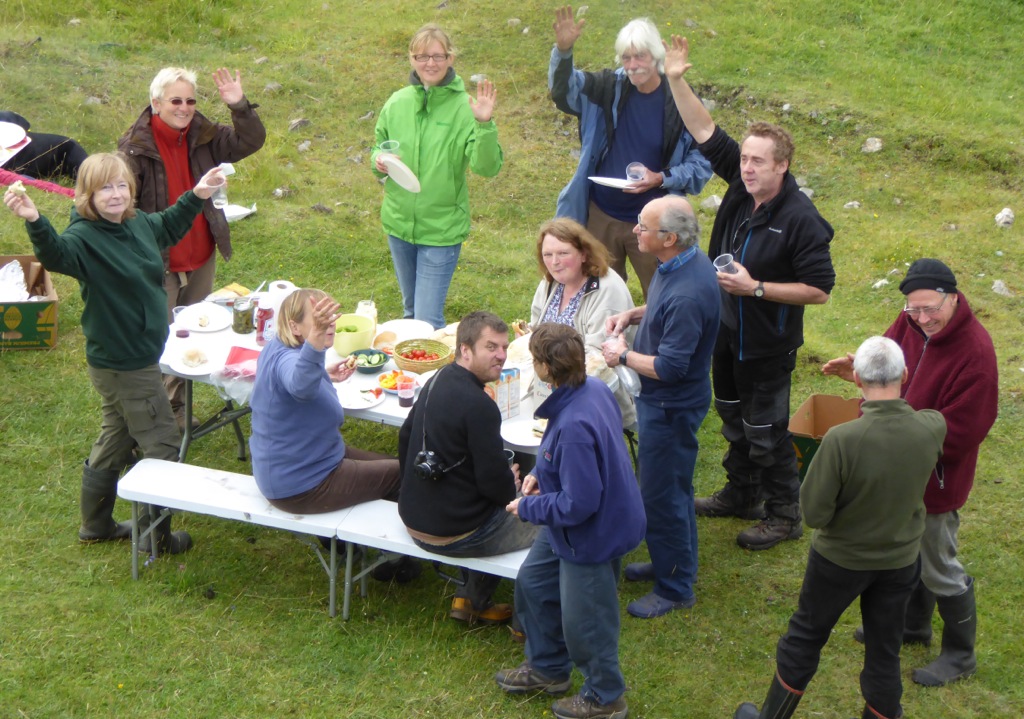
Meanwhile, since the firing would take at least 24 hours, we had a barbecue
When all the anthracite had burned and the kiln was cold, we took it apart. The pieces of limestone, now quick lime (shell lime) were recovered:

Lime burning at Park 25 October 2016

Lime burning at Park 25 October 2016
Adding water carefully, the pieces of shell lime heated up and began to disintegrate, finally resulting in powdered slaked lime.
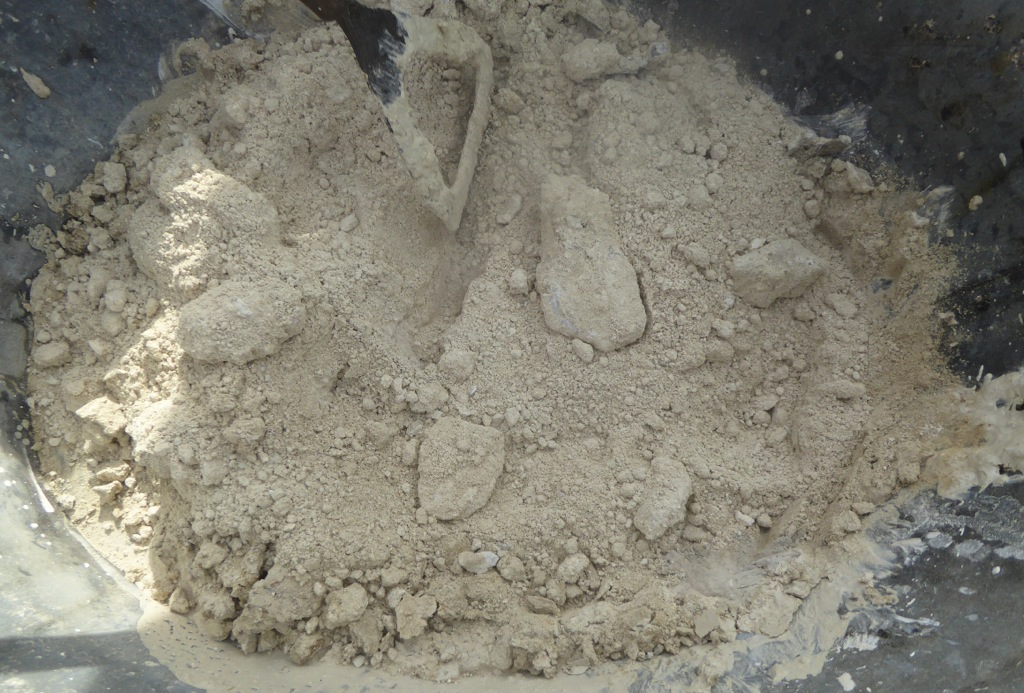
The Product: Half a bag of slaked lime for lime washing the Museum Cottage

The successful team of lime burners
Our thanks to Valerie Gilmour for permission to burn on her land.
Part Two: Burning with Wood
It is likely that, for hundreds of years, coal has been used in the lowlands to burn lime. However, apart from a small source in Brora, there is no coal in the Highlands and Islands, and limeburners had to rely on other fuels, predominantly wood. This required a great deal of skill in maintaining the kiln at a sufficiently high temperature for prolonged periods, because the energy content of wood is much lower than coal.
After the success in burning with coal, we had a try at burning with wood, using a ton of seasoned larchwood supplied by John Carmichael.
The “kiln” started with a bed of very dry kindling, placing the pieces of limestone in the centre of the wood pyramid and firing from the top.


Part Two: Burning with Wood
Wood was added to keep the fire burning vigorously for 8 hours

Part Two: Burning with Wood
After a further 4 hours in hot embers, the product was recovered from the “kiln”

Part Two: Burning with Wood

Part Two: Burning with Wood
The small pieces of limestone had burned completely, and yield slaked lime on wetting

Part Two: Burning with Wood
But the temperature had not been high enough for long enough to burn the larger pieces, which showed slaking only of the surface layers to a depth of around 5mm in some cases.

Part Two: Burning with Wood
This was a first experimental burning with wood but there were at least three important lessons: break up the limestone into small pieces; enclose the burning to conserve heat; and have enough dry fuel to burn for longer, say 24 hours.
Our thanks to Ron Livingstone for allowing us to burn lime in the limestone quarry at Park.