
Lismore’s contribution to Homecoming Scotland in August 2009 was a celebration of the island, its people past and present, and its abundant talent. The minibus, provided by Mrs Yeoman of Glensanda, was busy for all events and the effort put in by the organising committee – Jennifer Baker, Donald Black, Margaret Black, Laura Gloag, Bob Hay, Barbara McDougall and an army of voluntary helpers – was never obvious as it all flowed flawlessly.

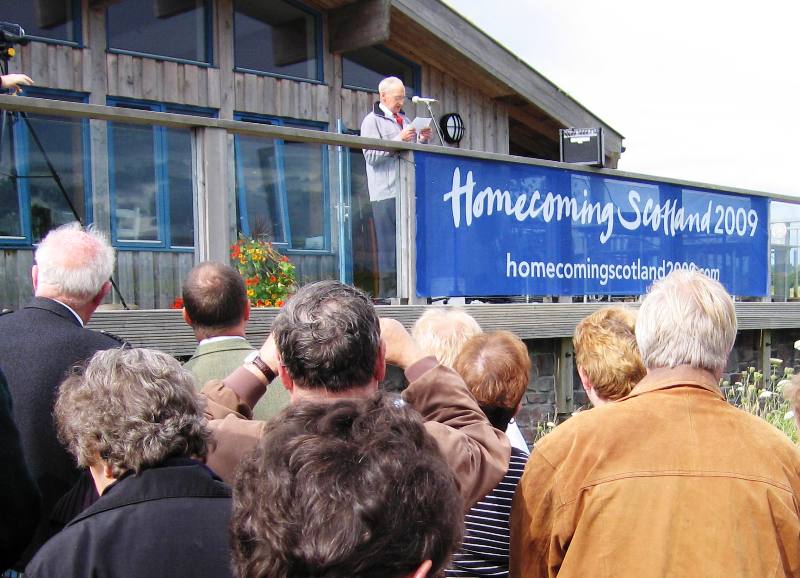
Duncan Livingstone opening Homecoming Scotland 2009

Oban Gaelic Choir
Saturday 8 August 2009
It opened at 4pm on with a formal reception for descendants of emigrants, visitors and islanders held at the Lismore Heritage Centre. Ronald Black’s piping echoed around the arriving crowd who gathered to hear Duncan Livingstone welcome them in his native Gaelic and in English. The Oban Gaelic Choir then sang two songs followed by Mary MacDougall singing An t’Eilean Aluinn, and, in conclusion, the Rev Roderick Campbell gave his blessing before drinks and snacks were distributed to the crowd.

Walking Theatre and Lismore Youth theatre
A great hit of the week was Argyll’s award winning Walking Theatre Company in a production with Lismore Youth Theatre which they performed everyday. Written by Sadie Dixon-Spain, it told of the Carmichaels of Lismore whom we meet in 1745 as men are being sought for the Battle of Culloden. As we walked through the land and the generations towards the now abandoned weaving village of Port a’ Charrain, we met various authority figures who would sweep the very ground from under the families who were cleared in the 1850s.
Visitors and descendants of Liosachs were greatly moved and impressed by this dramatic use of the land which tells its own silent story in the many deserted townships such as Port a’ Charrain. As Mrs Carmichael says at the opening of the play, “On Lismore everyone is indeed welcome home” and also welcome to share her scones of course.

Walking theatre with Lismore Youth Theatre

Walking theatre and Lismore Youth Theatre
Dinner and a Ceilidh
The celebrations continued with a shared meal in the hall at 6pm, and at 7.30 a ceilidh with Ronald Black opening with more stirring piping and Katy Crossan, a splendid host, welcoming all in Gaelic and English. Davie Garret (pipes), Murray Willis (accordion), and Colin Black (guitar) who together play as Balaich Lios Mor (the Lismore Boys), got the evening off to a foot tapping start followed by Sarah Campbell singing and accompanying herself at the keyboard with harmonies provided by her sister Mairi.
The Oban Gaelic Choir with Sileas Sinclair sang songs from Ballahulish, Mull and Lismore, and Chris Small read his poem “The Migrants” describing the travelling of swallows. Mod gold medal winner Mary Catherine MacNeil from Barra, a member of the Oban choir, sang movingly and the first half ended with The Cast, Mairi Campbell on voice, viola and fiddle and her husband Dave Francis on guitar.
After tea and home baking the second half had items from Sileas Sinclair on the box, Morag MacNeil and Graham Campbell also from the choir, singing, and a very entertaining spot from Lachlan MacDonald who sang his native Gaelic songs and did some very impressive and hilarious stand up. The concert ended with The Cast’s wonderful version of Auld Lang Syne made famous when used in the film “Sex and the City”. That was Saturday.

Oban Gaelic choir

Piper Ronald Black

Morag MacNeil
Sunday 9 August 2009
Church and graveyard
The Rev Dr Roderick Campbell welcomed a packed Lismore Parish Church to the Homecoming Service during which greetings were read from Australia, Canada, the USA and one from New Zealand which John Livingstone read in Maori from his son Iain in Auckland. Homecomers whose forbears had left Lismore also took part: Gaye Strange from Brisbane read from the Old Testament and William Black from Ontario read from the book of Revelations. Lachlan MacDonald, a Liosach, read the gospel in Gaelic and English and Mary MacDougall, also a Liosach, sang Amazing Grace in Gaelic. After the service the congregation enjoyed a shared meal in the grounds of the wee manse laid on by members of the guild and church.

Homecoming Church service

Homecoming Lunch at the Manse
After the meal Robert Hay conducted an extremely informative tour of the graveyard, pointing out among other interesting graves, the medieval carved gravestones which are a subset of the 600 or so that have survived in the West Highlands. The unique feature of the Lismore stones is the occurrence on two stones of the “tau-headed staves” which are rare in the British Isles but familiar in the eastern Mediterranean. These stones, he said, represent a major artistic achievement and it is of great concern that so many have been lost, damaged, defaced, or merely neglected.

MacCormick gravestone

Homecoming 2009 graveyard tour 9.08.09
There was much to be seen at the Museum and Monday 20 July was “Drop-in Day” when, at their own pace, visitors and locals were invited to view the new museum displays (including emigrant letters and photographs; and the 100th anniversary of the Lismore Bard, Hugh Anderson); to take part in the opening of the Genealogy Centre; and to see the display of “Lismore Faces” a book of historic photographs and the release of the Emigrant Register in CD format.
Monday 10 August 2009
Drop in day at the Museum . The Walking theatre and Lismore Youth Theatre preformed at 4pm
Tuesday 11 August 2009
Emigration Seminar
The hall was packed at 2pm for an Emigration Seminar with locals as well as many visitors from, among other places, the Morvern Historical Society and Lorn Archaeological group. Dr Lucille Campey, a Canadian author of several books on emigration to Canada, started with a talk on “The Exodus from the Highlands and Islands to Canada: push, pull and opportunity”, giving the Canadian perspective and telling us how it differed from accounts written by Scottish historians.

Homecoming 2009 Emigration Seminar 11.08.09
Many of those who went to Canada, she said, paid their way and, along with those who were cleared from their land, often prospered but, as she added, we do not know about those who did not do well.
Freya McCracken, a PhD researcher from Aberdeen University, told us she is piecing together the lives of those emigrants through their letters which, although a patchy history in places, was nevertheless very interesting as letters revealed ordinary daily lives, their joys and their sorrows. Freya is interested in hearing from anybody who may have letters from emigrants stashed away and asks that they contact the museum (01631 760 030) for her details. Robert Hay and Laura Gloag both spoke about how the Museum was gathering the stories of Liosaich through the ages which was a growing resource for all those seeking their roots.
The afternoon finished with a moving song from The Cast – Mairi Campbell and Dave Francis – based on letters from home to those who are far away.

Homecoming Ceilidh 11.08.09
A full evening of ceilidh dancing started at 7.30 in preparation for the closing Ceilidh Dance on Friday night. Many people took advantage of the excellent instruction on offer from Mairi Campbell and her trio.
.Wednesday 12 August 2009
Walk to Achanard
This was the homecoming in reverse when a good sized party went from Kilcheran in persistent rain on an organised walk to the township of Achanard, the site of the first clearance in the 1780s. At the township which once housed many people, their story was told by Bob Hay and Catriona White, a moving poem “Hope” about the moment some villagers heard the news they were going to Canada, was read by its author Margaret Black, and piper Angus Nicolson evoked the many moods especially with the wistful “Mo Dhachaidh” (my home). You can read the full story of Achanard in the history section of this site.
Thursday 13 August 2009
Meet the Authors
As part of Literary Homecoming 2009 on Thursday morning readers gathered in the Museum Library to meet two of Lismore’s three authors – Donald Black and Robert Hay and to hear from Margaret Lobhan (who couldn’t make it) with Cathie Carmichael speaking for her. A most interesting discussion centred on their three very different books about Lismore, and ranged widely over the place of Gaelic culture and language in the past and the future.
Meanwhile in the marquee, children and anyone else interested in the Granny Porage stories, were meeting Jean Marshall who read from her much loved books which are set in a “wee cottage all by itself on an island” where lived “a little old woman, who was known to everyone as Granny Porage.”

Jean Marshall and Granny Porage

Children with Jean Marshall and Granny Porage
Storytelling
Thursday afternoon’s storytelling in the homecoming marquee was a very popular event where an appreciative and large audience listened to Lismore tales from Lachlan MacDonald, a raconteur of great talent and humour, Malcolm McCorquodale giving us Port Ramsay tales of his grandparents and extended family, and with tales of Liosachs who took part in the first world war from Ailsa Clark and David Clark. There was also a special tale about Highlanders who went to work in the weaving of the famous paisley shawls etc, as the money was so good and their skill so valued.

Lachlan MacDonald

Ailsa Clarke
Friday 14 August 2009
Ceilidh Dance
Friday’s Ceilidh dance was hosted by Agnes MacLean of North Connel. The line up of visiting performers included the Mod gold medallist singer Raymond Bremner, as well as F Ann MacLean, Morag Smith, Charlie MacColl, Jimmy Cameron and piper Calum MacColl who opened the evening. The visitors were joined by local performers Duncan Livingstone, Mary MacDougall, Laura Cook, Katie Wright, and Murray Willis on the accordion.

Calum MacColl

Visiting Gaelic singers
Homecoming Lismore 2009 Sponsors The organising committee of Homecoming Lismore 2009 would like to thank the many people who contributed time and energy to make the week so successful and they are indebted to the following sponsors: Argyll & Bute Council , LEADER funding, Mrs Yeoman, Calmac, William Lundie & Co, and the Oban Gaelic Choir who gave free performances.