
Donald Black (1928– October 2013).
The following is Dr Iain McNicol’s tribute delivered at Donald Black’s funeral service in Lismore church.
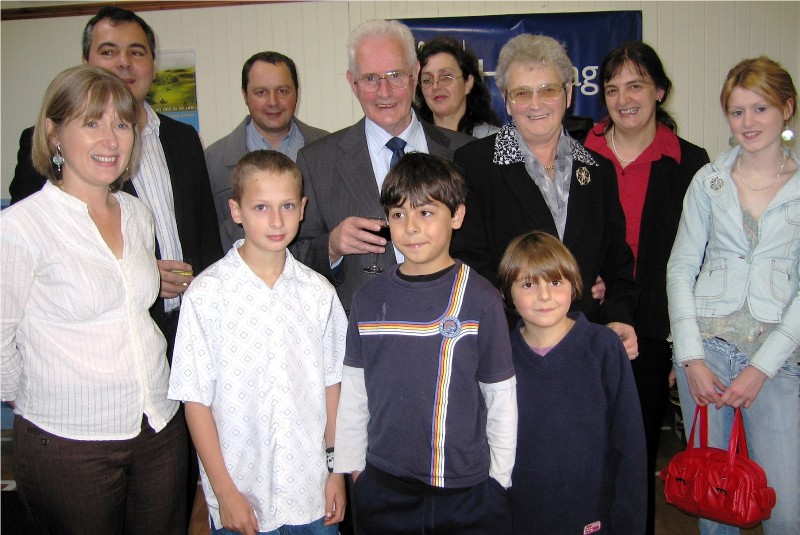
Donald Black, Roma and family
Donald Black was my friend. Donald black was a friend of everyone in this church today and everyone on this island and many beyond its shores as witnessed by the numbers crossing on the ferry today.
We have heard of Donald’s many skills and interests – art, athletics, crafting and especially family but, as Donald moved towards retirement a whole new chapter began to open in his life.
Initially Roma was providing the nursing care on the island and, as the population had dropped to 85, the Health Board were trying to do away with a nurse on the island but Roma, with support from Beth Campbell, held the service together with a 24 hour service despite only being paid for 2 hours per day. Donald always supported her in this and I remember whenever she was called to emergencies, particularly at night, Donald was always there in support; driving, holding a torch, lifting a stretcher, holding a drip bottle, helping doing whatever was needed without a thought of payment and usually calming a situation with a Gaelic tale.
They then had the nightmare of Rachel’s accident which they coped with with compassion and dignity fortified by a strong religious belief.
Gilleasbuig and Norma returned to the island, which delighted Donald and Roma, to raise their three children, Eoghan, Sara and Colin and Morag married Klaus providing two more grandchildren, Alexander and Charlotte.
During this time, Donald was embarking on his Gaelic projects. At 60 he was asked to write the Gaelic column for the Oban Times so he taught himself to write Gaelic and wrote the column for several years.
He then set about compiling a book of Lismore Tales which was eventually published by CADISPA in 2006 with Donald’s beautiful drawings enhancing his words. It became a classic of Lismore Gaelic culture.
He, along with Margaret MacDonald, Cathie Carmichael, Mairi Smith, Duncan Livingstone, John Livingstone, Archie MacColl, Jimmy MacCormick, Duncan MacGregor and others set about rekindling a pride in Lismore Gaelic culture setting up the Comann Eachdraidh with the goal of a permanent Island heritage Centre. They quickly got a lease on the empty schoolhouse and started gathering artefacts and archive, holding meetings and running weekend Gaelic courses.
The Gaelic world started to recognise Lismore’s strong Gaelic culture and language and Donald became a regular voice heard on radio and television as the momentum gathered towards fundraising for a purpose built Heritage Centre.
In the middle of all this activity, or perhaps because of it, Donald chose to give us all a scare. At 6 o’clock on a sunny Sunday morning in June 2000 Roma phoned to say that Donald had suffered a cardiac arrest. Mairi Perkins was present. As I crossed the ferry, Jimmy Thompson and I hardly spoke and I drove down the island with a heavy heart feeling that this was going to be an awful day on Lismore. Happily, on arriving at Achnacroish, I found that Roma and Mairi had got his heart going and, although unconscious when taken to hospital, he quickly made a full recovery and was back home in a few days and returning to his old self.
Duncan MacGregor and family then kindly and generously donated a large piece of land for a heritage centre and café to be built. The Centre opened in March 2007 and is a legacy to Donald and to the members of the Comann Eachdraidh who dared to believe in the value of the Gaelic culture and language and is now the centre of the economic reformation of Lismore, the proof of which is that the population of this magnificent island has risen to about 200 (from 85) and there is a vibrancy in the island which augurs well for the future.
Remarkably, Donald, in his retirement, had achieved his lofty ambition and could have sat back to reflect on his glory but that was not his style. He continued to join in and enjoy the organic growth of the Centre and has been able to hand the baton over to a new generation of talented and able people – like the good athlete that he was.
Donald never recognised what an incredible talent he had for making others enthusiastic about Gaelic. As an example, I would like to cite my own son, Padraig, who left school after 11 years of “studying” Gaelic and decided he wanted to go to Sabhal Mor Ostaig. He was very positive about the interview until he was told that all tuition was in Gaelic. “No way” as, after 11 years at school, he had very few Gaelic phrases. I contacted Donald and Margaret MacDonald and they took Paddy over to Lismore and, within 6 weeks, had transformed his pidgin Gaelic so that he was able to pass the entrance exam and go on to get his degree and transform his life.
Donald, with only a primary school formal education, never realised the immense ability he had as an educator but many people of all ages and abilities fully understand and appreciate this. Donald feared no man and believed that no man or woman was better than him (except perhaps Roma) but, equally, Donald respected everybody.
Over the past 18 months Donald suffered a lot of medical problems but Roma feels so grateful that she was able to keep Donald at home and care for him and be with him as they had for 54 happy years of marriage. Roma did the necessary whilst Donald sang the Gaelic song!
Donald’s legacy is a living Gaelic Cultural Centre, a classic book on that culture, some lovely paintings and a wonderful, devoted family – Roma, Duncan, Morag, Klaus, Gilleasbuig, Norma, Rachel, Colin and all the grandchildren.
Donald was a highland gentleman and a giant of Gaelic culture whom we were privileged to know. Moran taing.
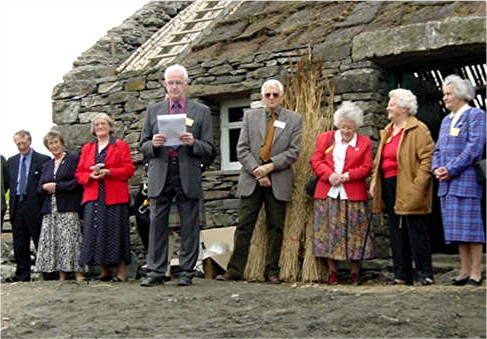
Donald Black opening the Cottage 19 August 2002