
In 2015 The Heritage Lottery Fund finally approved the project to lift, clean, repair and display eight of our best medieval stones in the graveyard. They stand between the church and the war memorial . There is a leaflet beside the display and below is the detailed Information on each graveslab.

Slabs with completed facing walls and interpretation boards
The classification of West Highland graveslabs into distinct schools operating at a few sites, and the dating of the stones, are now under active review. The fact that most of the Lismore slabs are carved in slate (rather than the classic chlorite schist) suggests that they may actually be of local provenance. The following includes the description of each stone from the RCAHMS Inventory (1975), and some additional notes. Current petrographic research on the different materials used should enhance our understanding of the origins of the graveslabs.
As many of the slabs do not include any form of Christian symbolism, but feature swords, symbolizing military power, it has been proposed that they commemorate a warrior class: the “West Highland samurai”.
Stones 1 and 2. Iona School (identified by the botanical details), both described as 14-15thC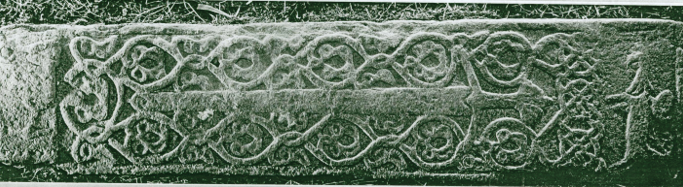
Tapered slab, 1.71m long by 0.39m wide at the head. At the top, a stag with a bird on its hindquarters is being attacked by a hound. Underneath this there is a row of three ring-knots linked together, and then a sheathed sword flanked by double plant scrolls, while at the foot of the slab is a casket and a pair of shears. The sword has a lobated pommel and canted quillons, and the scabbard ends in a chape.
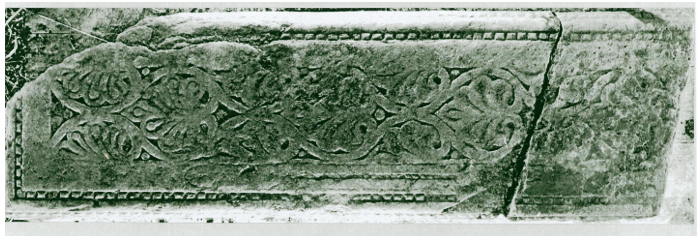
Parallel-sided slab with bevelled edges, measuring 0.47m in width over all. It is now only 1.55m long, the top of the stone, as well as one of the corners, having broken off. A narrow central panel contains a double scroll incorporating the palmette device, while in the right-hand margin there is a sword of Viking ancestry with lobated pommel, a short horizontal guard, and a scabbard decorated with a thin strip of cable pattern. The border and edges of the slab are enriched in each case with a single row of elongated nail-head ornament.The shears and casket at the bottom of stone 1, and the sword on stone 2 are now barely visible.
Stone 3. Lochawe School (identified by simplified botanical details), described as 14-15thC.
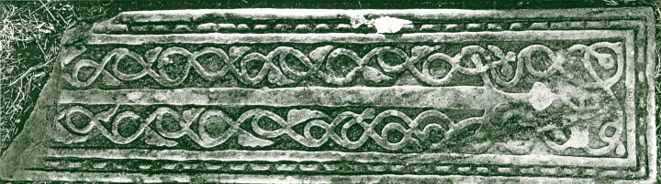
Loch Awe School
Tapered slab, the bottom of which has broken off. It measures 1.78m in length by 0.48m in width at the head. Within a wide border, consisting of two plain mouldings separated by a row of elongated nail-head ornament, there is a sword with a similar hilt to that on (1) above, but longer in the blade. The sword is enclosed by plant scrolls of simple design, which are linked to the hind-legs and tail of an animal placed above the pommel.
Weathering has removed details of the head and forelegs of the animal (top right) but it is likely to be a hound. This stone, presumably moved from its original position, was reused to mark the burial of the Carmichael armour-bearer to Stewart of Invernahyle (see below), to the north of the church.
Stones 4 and 5. Similar to stones at Kilmichael Glassary. 16th C.
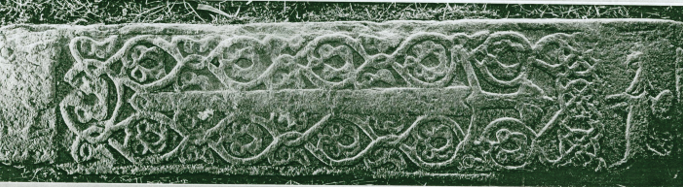
Lid of a tomb-chest, parallel-sided and measuring 1.66m in length by 0.68m in width. Down the centre there is a fine representation of a two-handed sword, or claymore. It has slightly-inclined quillons with pierced quatrefoil terminals, a rounded pommel, and a long langet. Above the quillons are a lion (or dragon) and a griffin, and stemming from their tails is a mass of foliage which fills all the remaining space within the border. The border is enriched with a row of debased dog-tooth ornament. The sculptor who carved this slab was also responsible for (5) below, and for two tomb chests at Kilmichael Glassary
The fact that the sides of this tomb chest are missing indicates that it was moved from its first position. Lying to the north of the church, it was thought to commemorate Donald Stewart of Invernahyle (Domhnull nan ord, Donald of the hammers –referring to his immense strength) who led the Stewarts at the Battle of Pinkie (1547).
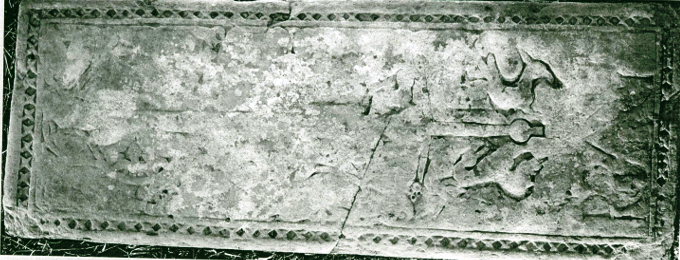
Lid of a tomb-chest, 1.69m in length. Although it is slightly tapered, it is too wide at the foot (0.60m) to have been a recumbent slab. The decoration is heavily worn but has been similar to that of (4) above, which is by the same carver. At the top there is a secondary inscription which contains the date 1661 and a name, possibly M D [O] W
This very weathered stone is very similar to stone 4 except that the heads of the lion and griffon stretch upwards. Again, the sides of the chest are missing and the17th C carving indicates that it has been re-used.
Stone 6. Local carver? The “Lady Stone”, described as 15-16thC.
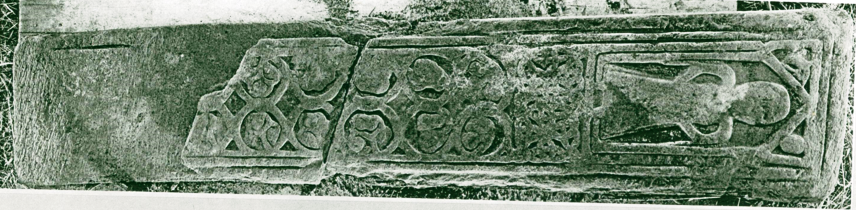
Tapered slab, 1.86m long by 0.43m wide at the head. It is broken across, and part of the decoration at the foot has scaled off. Within a niche at the top of the stone there is a small figure of a woman, facing the front and with arms akimbo. She is wearing a close-fitting hood, and an ankle-length kirtle over which is an outer garment, possibly a cote-hardie, with long flaps (tippets) hanging from the elbows. Beneath the niche there is a band of interlace, and then an overall pattern of interlocking plant-scrolls. A crude piece of work by a local carver, the slab presumably dates to within the period 1400-1560.
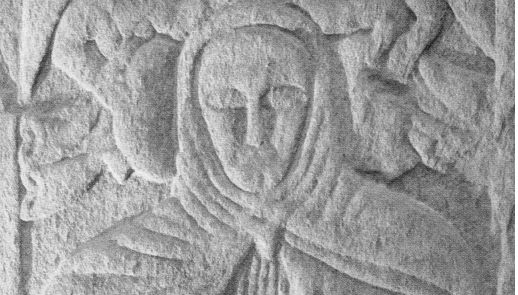
In portraying a lay woman, this stone may be unique amongst West Highland graveslabs. Her identity as a woman is attested by her bosom, long garment and tippets, possibly by her arms akimbo. What appears to be a beard is actually the gathering of her hood under her chin (as shown more clearly on the graveslab of Canon Bricius MacMhuirich on Oronsay – see below).
Stone 7. Attributed to the Loch Awe School, described as 14-15thC.
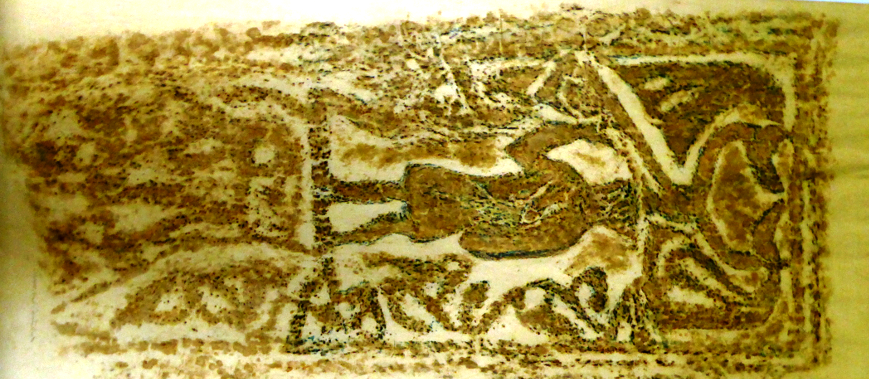
Textile rubbing of stone 7 revealing weathered detail
Tapered slab, 2.02m long by 0.70m wide at the head; it is broken across and badly worn. The border is enriched with elongated nail-head ornament, but within this all that can be seen is a small effigy of an armed man standing in a niche crowned by dragons’ heads, and traces of a pair of indeterminate creatures situated immediately underneath the niche. The man is wearing a pointed basdcinet and an aketon, and carries a sword and a spear.
This massive stone (the base behind the shelter) is said to commemorate a giant warrior, An Gorm Mòr, who fought an epic battle either with the devil or a wild bull on Morvern. Much of the detail shown in the textile rubbing has been lost by physical damage in recent years.
Stone 8. Local carver? Described as 15-16thC.
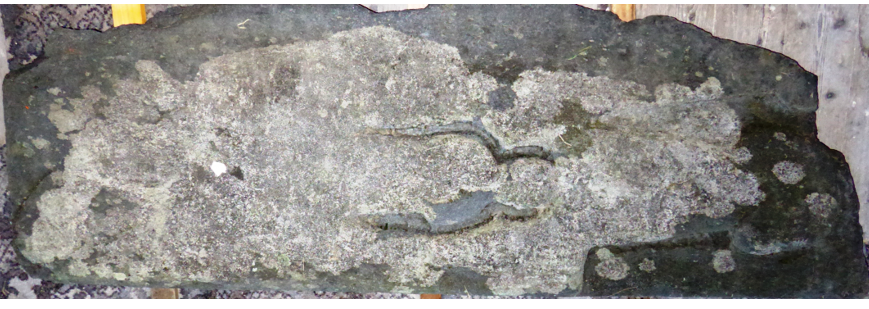
Fragment of a slab, 1.5m long. It bears the deeply incised outline of the upper half of a small figure of a man. Possibly a priest, standing beneath what may have been intended for a canopy. Another crude local product. Probably 1400-1560
This stone appears to be a fragment of a larger carving, possibly recovered from the ruined nave.
The RCAHMS Inventory includes three further stones not displayed in the shelter, each with Christian symbolism. Two stones show the Tau cross symbol, unique in Scotland but common in the Eastern Orhodox Church. It has been speculated that this is evidence of MacDougall involvement in the crusades.
Stone set into the floor of the church, traditionally said to commemorate Duncan Stewart of Appin, murdered at Duart in 1519. This is clearly a re-used stone. Attributed to the Iona School, 14-15thC.
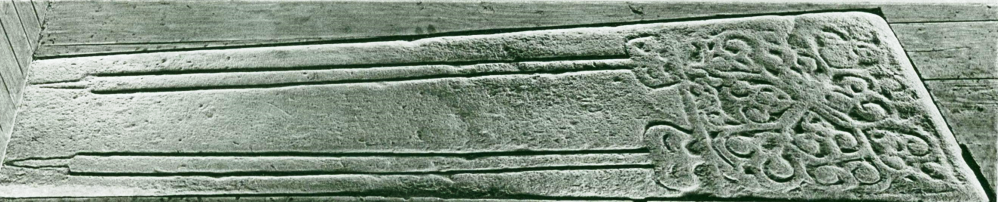
Tapered slab, 1.73m long by 0.46m wide at the head. Beneath a foliated
cross there are incised representations of a pair of tau-headed staves, similar to, but more stylized than, the stone below. The shafts expand slightly towards the foot and terminate in long spikes. These liturgical instruments may indicate that the stone marked the grave of one or more ‘chanters’ (precentors) of the cathedral.
Fragment of a graveslab housed in the Lismore Museum for security. Attributed to the Iona School, 14-15C.
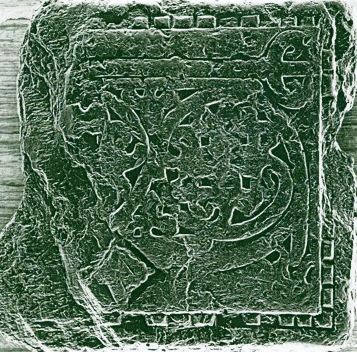
Upper portion of a similar slab to the last, 0.46m long. The only differences are that the scroll issues from the jaws of an animal and contains clusters of trefoils in place of the palmette, while the sword in the right-hand margin is balanced by a tau-headed stave. The tau-head is formed by two dragons which confront one another on either side of the shaft.
Fragment of a stone housed in the church, possibly Iona School, 14-15thC.
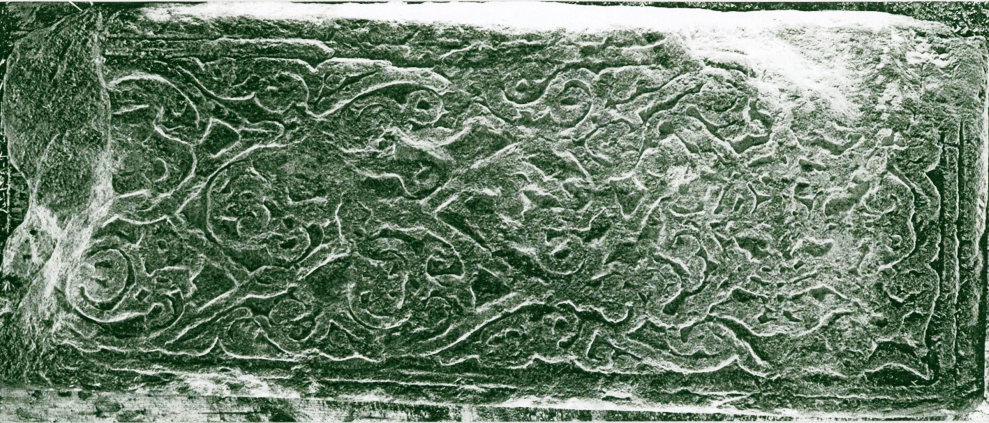
Upper half of a slab measuring 0.98m in length and 0.37 in width. Within a double plain moulding there is a cross at the top, composed largely of plaitwork, and below this is an overall pattern of interlocking plant-scrolls.
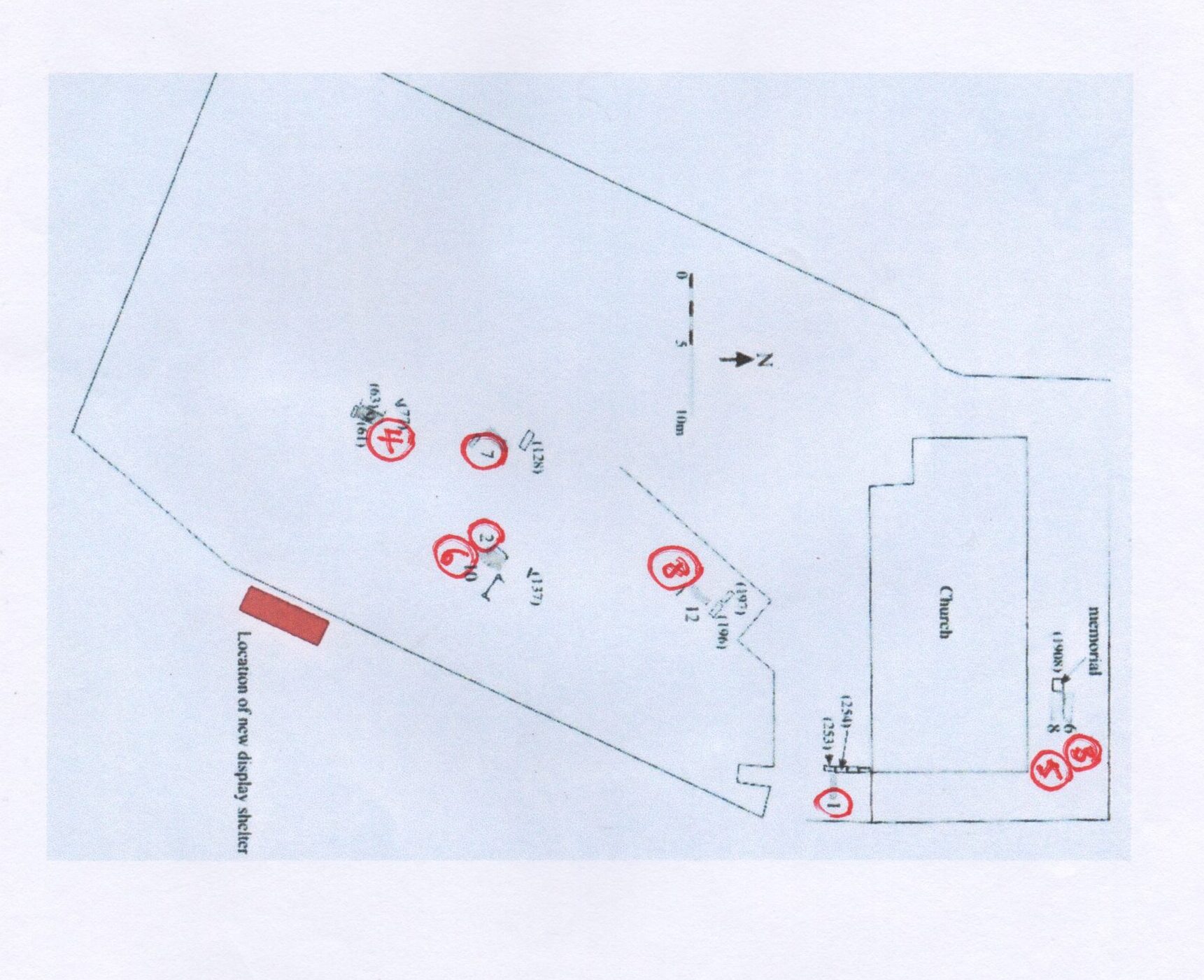
The original positions of each stone in the graveyard.
Glossary
Aketon A quilted coat worn under the armour or as an independent defence
Bascinet A light helmet, generally egg-shaped with a pointed apex
Chape The protective metal plate at the tip of a scabbard
Cote-hardie A form of tunic worn in the Middle Ages
Griffin a legendary creature with the body of a lion and the head and often the wings of an eagle
Langet A strip of metal projecting from the centre of the quillons of a sword over the base of the blade, as a protection for the hand
Palmette A decorative design of Greek origin based on the honeysuckle
Pommel The knob on the hilt of a sword
Quillon The arms forming the cross guard of a sword
Tau-headed Cross or crozier in the form of a T
Sources
Argyll. An Inventory of the Ancient Monuments. Vol 2. Lorn. RCAHMS 1975
Hay R K M (2016). The Lismore Lady and other Medieval Stones. History Scotland 16, 50-51.
Steer K A, Bannerman J W M (1977). Late Medieval Monumental Sculpture in the West Highlands. RCAHMS.
Caldwell D, Kirk S, Howard S, Ruckley N (2015). Oronsay’s Sculptural Heritage. History Scotland 15, 24-28.