
The Lismore Lighthouse, and its associated buildings including two dwelling houses, were built to the design of Robert Stevenson for the Commissioners of Northern Lighthouses by the contractor James Smith of Inverness at a cost of £4260 (around £4.3m in 2022). Smith’s work must have proved satisfactory as he was engaged by the Commissioners to build at least four more lighthouses. Eilean Musdile, is approximately 10 acres in extent and is separated from the main island by a sound of around 400m with rough rocky shores, and it does not dry at low tide. The principal access by boat is by a landing place in a small inlet on the west shore, and there is a freshwater well, nowadays equipped with a windmill-powered pump. The island was purchased by the Commissioners from Charles Campbell of Combie for £500; this must have been a welcome bonus for Combie, as he had been trying to divest himself of his Lismore estate for some time, in order to concentrate on the development of Oban.
Eilean Musdile’s first principal keeper was Robert Selkirk (1779-1846), a descendant of Alexander Selkirk, the inspiration for Daniel Defoe’s novel “Robinson Crusoe”. From 1807, he was a member of the crew building the Bell Rock lighthouse, later being promoted by Robert Stevenson to be the principal builder. As Stevenson’s “right hand man”, he was the foreman of works for lighthouse construction at Kinnaird Head (Fraserburgh), Eilean Glas (Scalpay) and Pladda (Arran), amongst other projects. In recognition of his years of service, under the most arduous and dangerous conditions, he was given a “semi-retirement” post on Lismore, serving for eight years until 1841. He died in Edinburgh in 1846 aged 67.
Earlier travellers recorded that there was a prominent standing stone on the island. In 1784, the eminent French geologist Barthélemy Faujas de Saint-Fond described it as grey granite, 9 feet in height, 3 feet broad and 2 feet thick, without any signs of carving or shaping. As both Musdile and the main island are limestone, it is likely that a granite stone of this size (bigger than most glacial erratics) was brought purposely from the mainland in prehistory. Its original alignment with the linear arrangement Bronze Age cairns and cists on the main island may have been significant, or a simple consequence of the local landforms. Unfortunately, the stone disappeared during the work to build the lighthouse.
The Lighthouse
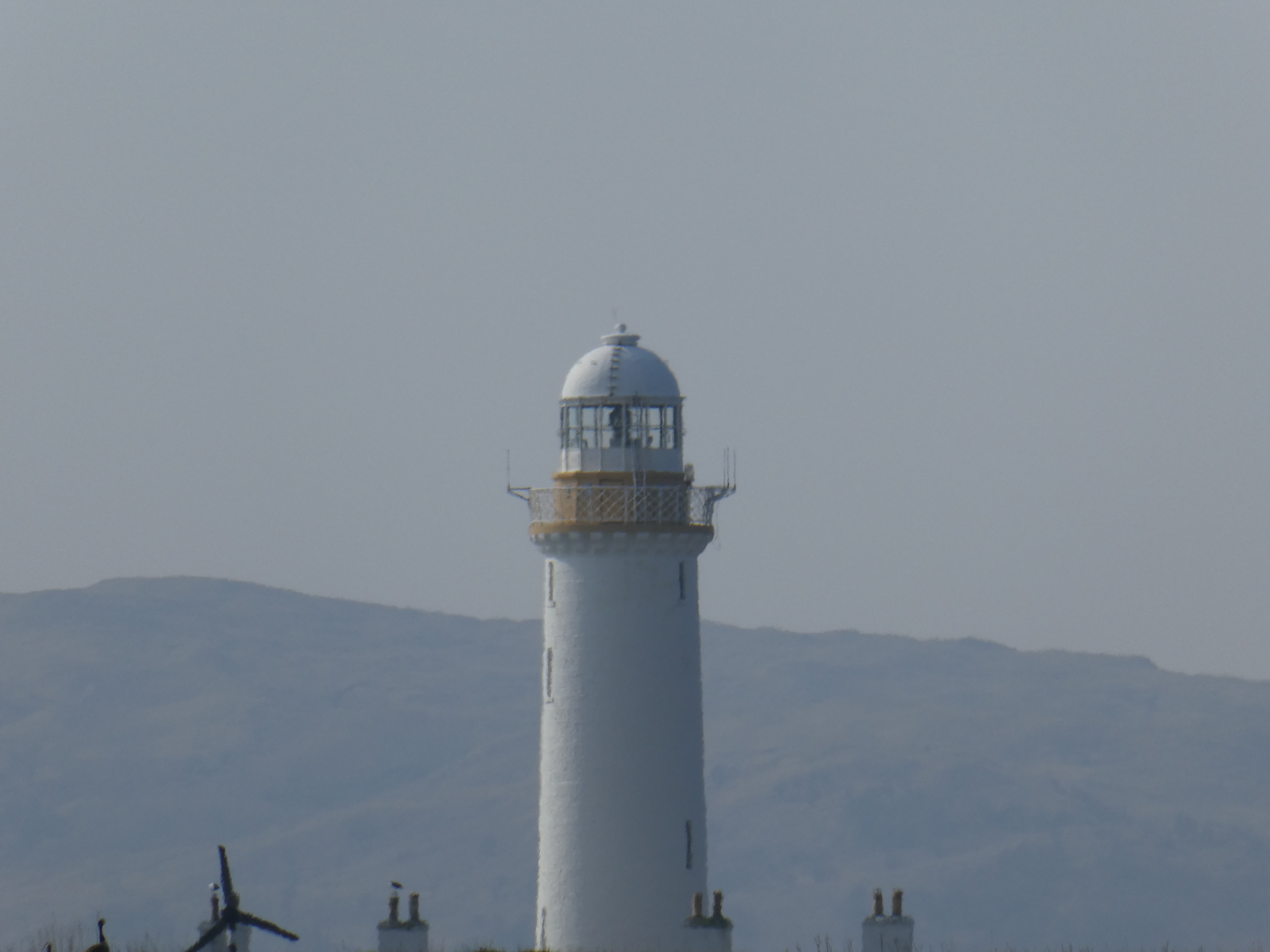
A classic tapering white cylinder, topped by a lantern dome surrounded by a gangway, at 26m in height overall, it was similar to many other nineteenth century lighthouses, but modest compared with Bell Rock (36m) and Tarbat Ness (41m). It is built of rubblestone, limewashed, with the details said to be Morvern sandstone. At its establishment, the fixed white beam, was provided by a “catoptric system” based on an array of, perhaps 15-20, Stevenson reflectors, each focussing the light from an oil-burning wick. In the 1830s, the fuel would have been whale oil, later succeeded by vegetable oils and paraffin.
The high quality of the fittings of the lighthouse can be judged from the leather-bound brass telescope inscribed “Lismore Lighthouse (Signalmen)” and “Adie & Wedderburn, Edinburgh”. Alexander Adie (1775-1859) was a leading instrument maker, supplying high-quality lenses from his Princes Street shop to famous scientists, including Joseph Hooker, Charles Darwin and David Brewster. He was also optician to Queen Victoria. This telescope was manufactured in the 1840s, when Adie was briefly in partnership, at the end of his career; it was part of the early equipment of the lighthouse.
The Duties of the Keepers
During the 19th century, Lismore lighthouse had two resident keepers (principal and assistant) who were joined briefly in 1841 and 1871 by an additional assistant. They brought their wives and children to live with them on the island. The lives and responsibilities of lighthouse keepers have been vividly portrayed in Margaret Elphinstone’s 2006 novel Light. The primary daily duties were to light the lamp wicks at dusk (using a tinder box before the days of safety matches), to douse them at dawn, and maintain a watch throughout the dark hours; to trim the wicks regularly; to carry oil from the oil store up to the lantern; to keep the reflectors polished; and to clean the glass of the lantern. The outside cleaning from the lantern gallery would have been exposed and daunting in wild weather; anyone living near the sea will testify to the difficulty of removing salt spray from window glass. They were also required to maintain a full log book including details of weather and shipping traffic; and ensure secure supplies to the lighthouse of oil for the lamp and coal for domestic use. Each year, there would be the very exacting job of limewashing the tower. Light keepers had to be patient, reliable, strong and meticulous in their work. The index to the General Order Book of the Commissioners testifies to the discipline of the Lismore keepers, including only three entries for fines in the nineteenth century: two (1852 and 1868) for leaving the station before the arrival of the temporary relief and one (1871) for “untidy premises”.
It was important for them to have stalwart wives, sometimes assisted by older children, to provide the normal necessities of life (food, clothing, laundry, carrying water from the well etc) – roles which were so much more difficult in a remote place. The boatman serving the keepers from nearby Point of Fiart would be able to bring regular supplies of provisions and mail from the main island, except in stormy weather, although it is likely that the families used the walled enclosures next to their houses to grow vegetables, probably keeping hens, and a goat for fresh milk. The manhandling of heavy loads of oil and coal from coastal smacks would have been hazardous and arduous. The 1861 version of the formal “Instructions for Lightkeepers” laid down strict arrangements for the boatman:
Rule 44: The Board will provide at Island Stations, when it is requisite, an Attending Boat at some convenient place of the adjacent mainland. The regular trips of the Boat to the lighthouse are not to exceed four in the month, – one at the beginning of the month for the Return, – one about the 15th, and the other two on Sundays, to enable Keepers, when and where practicable, to attend Church, – the Sunday trips to be so arranged as to be nearly intermediate between the 1st and the 15th, and between the 15th and end of the month.
Church-going lighthouse families would probably have opted for the United Secession chapel just over three miles away in Kilcheran, and later for Baligrundle (United Presbyterian ) Church, around 2 miles further on, rather than face the 15 mile round trip to the island Parish Church. Presumably there was a system of signalling between the lighthouse and the boatman, not least in times of emergency (serious illness, injury or the need of the services of a midwife).
Life and Death at the Lighthouse
The records of the Northern Lights Board for the nineteenth century show that there were consistently two keepers on Eilean Musdile; their spells of duty (around 4 years for the principals and 3 years for the assistants) were staggered without any overlap. The “Instructions for Lightkeepers” explain how relief, including cover for illness, was organised:
Rule 36: The Board will provide at each Station at least one person resident near the Lighthouse, who shall come under an agreement to always be ready to take the place of either Keeper, in case of sickness or other emergency. This person, called the “Occasional Light-keeper“, shall be duly instructed and qualified by a residence in the Lighthouse, and a course of training in the whole duty during not less than three weeks for Catoptric, and four weeks for Dioptric Lights. It is likely that the Point of Fiart boatman fulfilled this role for the Lismore lighthouse.
For keepers accompanied by their families, some time must have been devoted to the education of their children, who would not have been able to attend school. For example, in 1841, the household of assistant keeper, James Black, included six of his own children (4 girls, 2 boys, ages 8 to 15) and two stepchildren (boy and girl, 8 and 13). By 1851, when he had become principal, the family had dispersed, with only two girls remaining with their parents (16 and 22), but the new assistant, John Dawson, had three young children ranging from 2 to 6 years old, the youngest born on Lismore. William McLellan, the boatman who married the keeper’s daughter, in due course became a light keeper himself – in 1861 at Unst; 1871 Tarbat Ness and 1881 at Tobermory where he died from TB in 1885. From 1861, the lighthouse children were formally entered in the census returns as “scholars”, confirming the duties of the parents; following the passing of the 1872 Education Act, they had a formal responsibility to arrange elementary education.
Life on Eilean Musdile may not have been seen as very isolated in an era when the mobility of many members of the population was fairly limited. They had regular contact with the boatman based half a mile away at Point of Fiart and, once on the main island, they were within walking distance of the packet operating out of Kilcheran linking Lismore Oban & Mull until the 1870s. On the other hand, there were few people living on the main island near to the lighthouse, which was built just before the major clearance of people from the south end of Lismore. The furthest-south township of Fiart, which had supported eight or nine households (42 people, mostly tenant families) in 1841 had dwindled to a couple of cotter houses for shepherds by 1861. The records do provide one intriguing clue to contact with the local population: Harriet or Harriot Black, daughter of James Black (keeper 1841-55) was, by 1851, the 20-year old wife of William McLellan, the lighthouse boatman. In due course William became a light keeper himself – in 1861 at Unst; 1871 Tarbat Ness and 1881 at Tobermory where he died from TB in 1885.
History provides several examples of the deterioration of the mental health of keepers during long spells of service at isolated Scottish lighthouses. Although Mary McGregor, the Lismore minister’s wife, reported in her diary that 16 January 1868 was a stormy day, this did not prevent the Appin doctor, Robert McKelvie, from crossing over to the island with a police constable, with the remit to “remove” one of the keepers from the lighthouse. Dropping in on the manse after an abortive visit, they reported that they had been too late as he was already dead. His death certificate states that William Laidlaw (principal from 1865) had suffered from dyspepsia for several months and “acute mania” at the time of death. He was very quickly replaced as principal by John McDonald who served to 1872.
A Closed Community?
The records suggest that lightkeepers were members of a fairly enclosed society, commonly enlisted from keeper families, and moving relentlessly from one remote area to another without forming close local attachments. On the other hand, they had the security of lifetime employment and a pension at the end of their period of service.
The life of Patrick Ewing Reid illustrates the pattern to the full. He was born in 1836 to George Reid, keeper at Boddam, Buchan Ness lighthouse (Peterhead), and Marjory Ewing, who was also from a lighthouse family. Resident at Cape Wrath lighthouse, on 23 May 1860, Patrick married Sarah Sutherland, also the child of a keeper. In 1861, they were still at Cape Wrath lighthouse but, by 1871, he was principal at Kilbrandon in Argyll. However, the census records of their children show that, in the meantime, they had been at Chanonry Point, Rosemarkie; Isle of May; Sumburgh Head; and on Tiree. The next moves were to Fladda; Pentland Skerries; and Scurdie Ness lighthouse near Montrose by 1881. Their last postings were to Lismore (1889-1894); Noss Head (1894-1897) and Fladda (1897). Finally, the census found Patrick (65) and Sarah (60) retired in Edinburgh. After a very full life, including more than 35 years of lighthouse service, he died in Edinburgh in 1927, aged 90.
The 20th Century
The 20th century saw significant changes for Scottish lighthouses, including the move towards acetylene burners and, eventually, electrification. Spells of service of keepers were reduced, with regular relief, and it became unusual for families to accompany them at isolated sites. During the Second World War, the role of Lismore lighthouse became even more important, as convoys were assembled and dispatched from Oban Bay. The keepers appear to have been involved in only one serious incident: in 1940, rescuing two airmen from an RAF warplane that crashed in the Sound of Mull. By 1965, the Lismore lighthouse had been converted to automatic operation and the two dwelling houses sold to summer visitors.
This article would not have been possible without the wealth of information generously provided by Michael Strachan, Collections Manager at the Museum of Scottish Lighthouses; the copies of the Lightkeepers Records supplied by Alison Lindsay (National Records of Scotland) at a time of Covid-19 restrictions; and the help of Douglas Breingan, the unfailing source of Lismore lore, and Laura Gloag, the Lismore Genealogist. Margaret Elphinstone, the author of “Light” inspired this article.

Lismore Lighthouse
Lismore LIghthouse
Lismore lighthouse 3
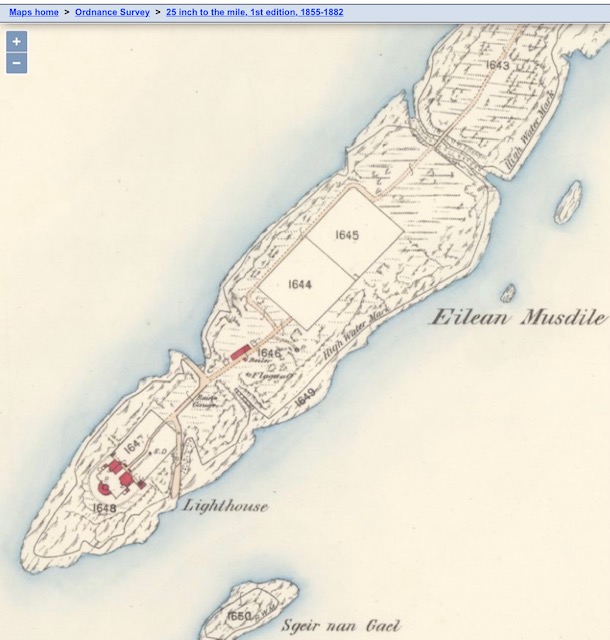
Eilean Musdile showing the west landing place, an alternative access and a set of steps to the east, connected by tracks (25 inch to the mile Ordnance Survey map, surveyed 1871) Reproduced by permission of the National Library of Scotland.

Lismore lighthouse 2
The seaways round Eilean Musdile

Parabolic light
Parabolic light reflector (diameter 615mm) designed by Robert Stevenson, showing the oil reservoir. Reproduced by permission of the National Museum of Scotland.
Lismore Lightpouse
Parabolic light reflector (diameter 615mm) designed by Robert Stevenson, showing the oil reservoir. Reproduced by permission of the National Museum of Scotland.

Lismore Lighthouse 7
The Lismore lighthouse telescope. L 70 cm extending to 87 cm. Objective end diameter 6cm. Lismore Museum accession LISDD:2018.238.

Lismore Lightpouse. 5
The Lismore lighthouse telescope. L 70 cm extending to 87 cm. Objective end diameter 6cm. Lismore Museum accession LISDD:2018.238.

Lismore Lightpouse. 6
The Lismore lighthouse telescope. L 70 cm extending to 87 cm. Objective end diameter 6cm. Lismore Museum accession LISDD:2018.238.